I was seeing Sorry at HERE at Outernet. I’m aware that feels like a poorly worded sentence. So to clarify, I was seeing the awkwardly named North London band ‘Sorry’, at the even more awkwardly named venue ‘HERE’, which is part of ‘Outernet’ – an ‘immersive entertainment district’ in Tottenham Court Road. I’d quite enjoyed Sorry’s latest album, Cosplay. I clocked a Guided By Voices sample in there. I was sold. There was also a Blue sample. Who was this band referencing both GBV and Blue? The ticket entered my basket quicker than you can say Anthony Costa.
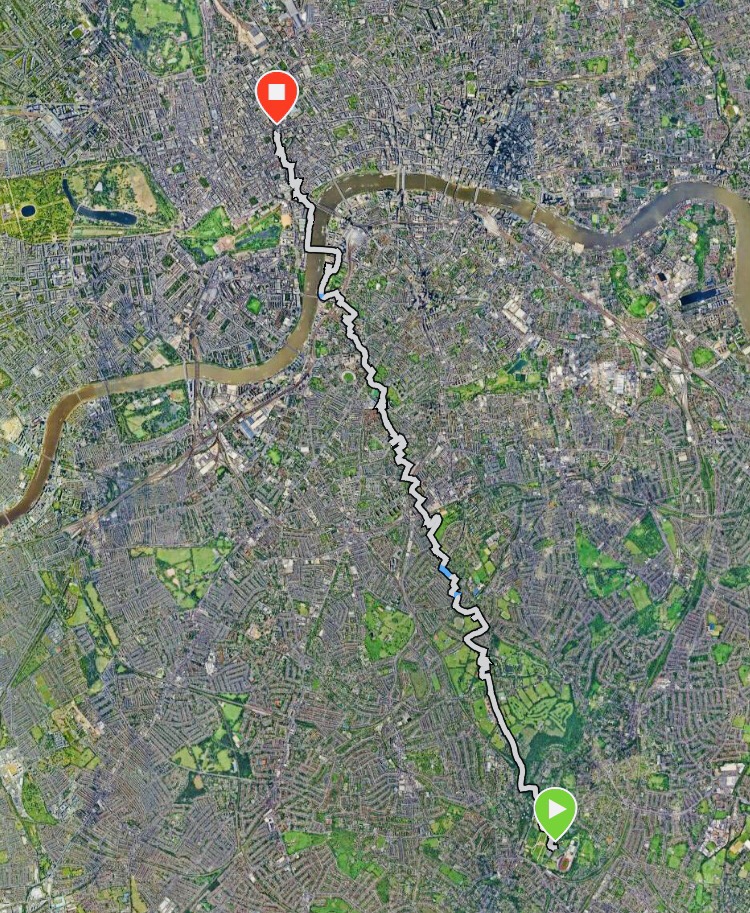
My mission? Walk in the most direct line possible from the Stonepenge monument in Crystal Palace Park to the gig, stopping occasionally to frequent pubs that fall directly on my route. This is a documentation of the sights, sounds, experiences, cognitive tangents and historical footprints of the journey.
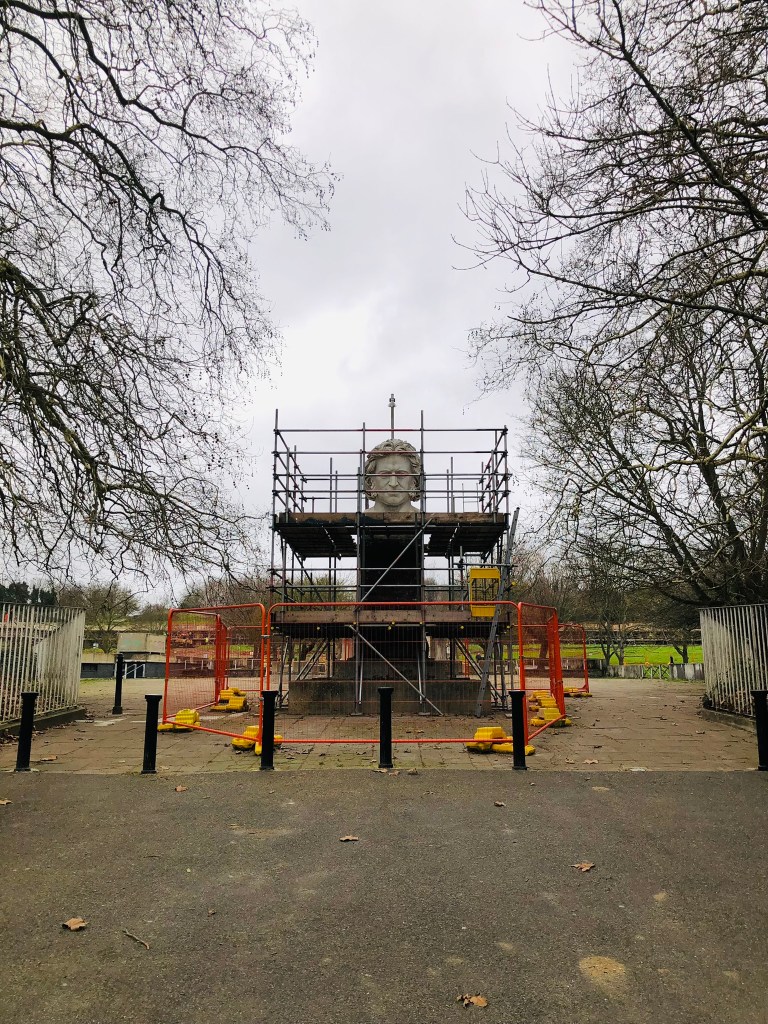
The first thing I noticed was that the Joseph Paxton bust next to Stonepenge was now encased in scaffolding. He’s the chap who designed the Crystal Palace, which once stood behind his massive sculpted head. I’m told this huge head will soon be relocated as part of the park’s regeneration.
After exiting the park and descending the incredibly steep Rock Hill, I found myself on College Road in Sydenham Hill. The pavement was a dusty, stoney dirt path – the kind of rustic charm you might find under your feet in a countryside hamlet. This vibe is reinforced by those little white wooden posts you get in postcard villages – like garden verge boundary posts, is the best I can describe them, if that means anything. Not to detract from Dulwich or Sydenham Hill, but it brought into focus the superficiality of the sense of a place feeling ‘nice’. I’d been heavily influenced by the absence of pavement slabs and the presence of white painted wood.
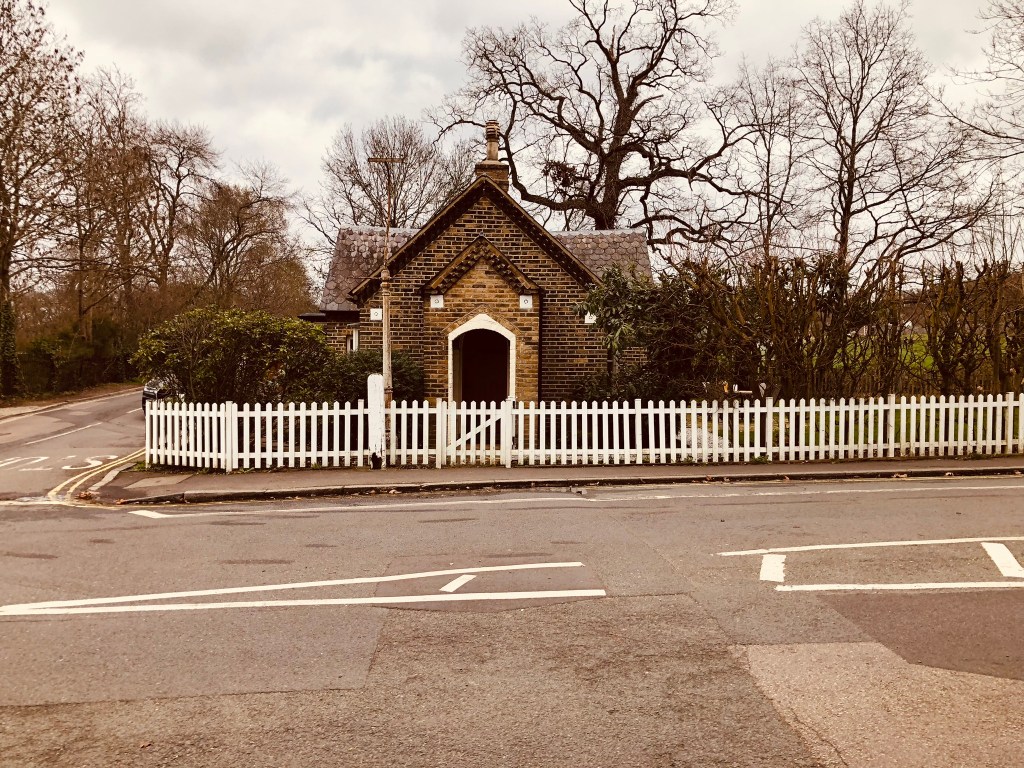
College Road has a working toll gate, the last of its kind in London. As I walked past I checked the toll booth. It was manned. I wondered what it might be like to work in a tollbooth. A transit van had ‘Cornice Store’ written on it. Did they trade solely in cornices? South East London’s premier supplier of decorative mouldings for the tops of walls. Posh kids played rugby in the playing fields opposite Dulwich College. Some kids even played working class sports, like football.
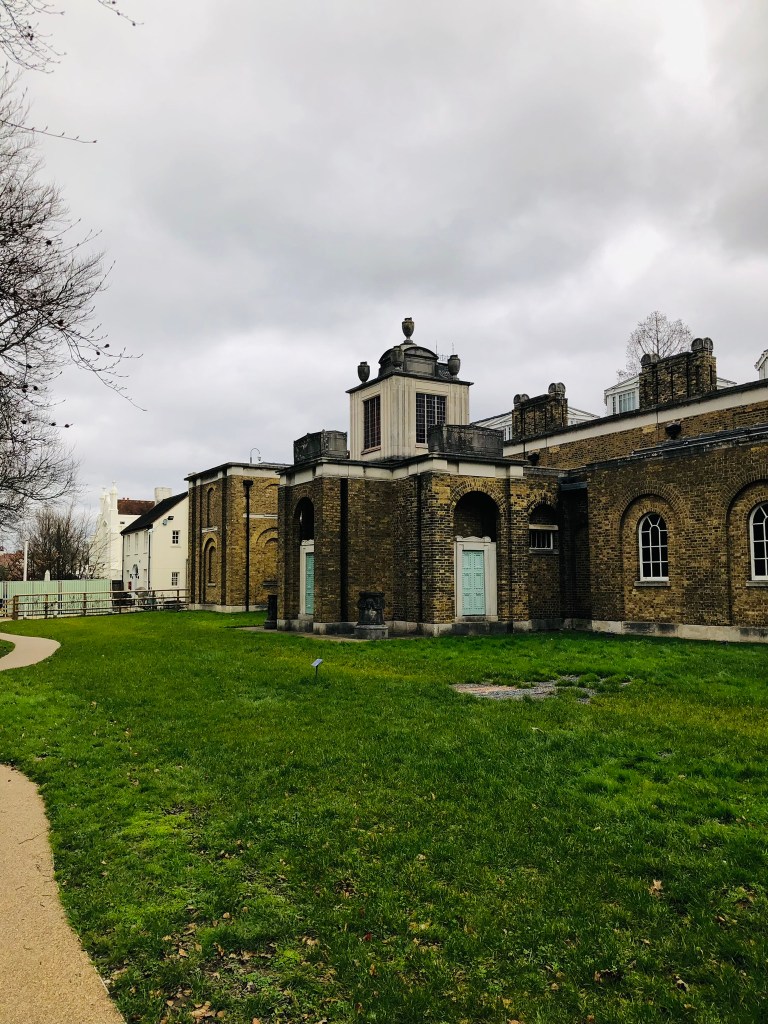
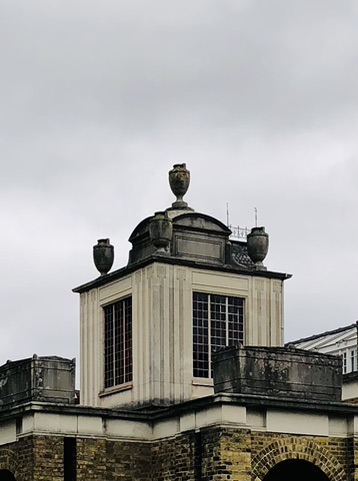
I cut through the grounds of the Dulwich Picture Gallery, closely hugging the Stonepenge to HERE ley line. On the west side of the building there is a Sir John Soane-designed Mausoleum where the Gallery’s founders are buried. A classic K2 red telephone box stands nearby. There is a connection. If you pay attention to that familiar semi-dome shape atop the telephone box, then cast your eyes to the mausoleum’s apex, you notice a striking resemblance. Giles Gilbert Scott’s telephone box design took more than a whiff of inspiration from Sir John Soane’s work. This specific roof-shape was a recurring motif favoured by Soane to provide an architectural pinnacle. The Dulwich Picture Gallery structure is just one example, but perhaps the most effective example as they appear side by side. Telephone boxes are effectively mausoleums these days – memorials to an all but obsolete public convenience, aside from periodic calls to Childline and Samaritans, where those in need seek anonymity.
Just down the road a stink pipe stood proudly before me. Stink pipes (or stench pipes) have become everyone’s favourite urban curiosity to point out. Once introduced to this malodorous world, stink pipes become strategically placed antennae reminding us of the fruits of paying attention to the overlooked street furniture all around us. They were erected by the Victorians to allow noxious gases to escape Joseph Bazalgette’s sewerage system, reducing the likelihood of underground explosions. Their towering nature owes to the need to hoist escaping shit fumes comfortably above nostril level. Their decorative flourishes owe to them being designed by the Victorians.
Bazalgette himself is a pioneer. Before his intervention, sewage would flow down streets, polluting rivers and gathering in cesspits. The label of ‘The Great Stink’ got slapped on this unfortunate situation in 1858 – a comical name with 168 years of distance, but at the time this would have been, in the words of Benjamin Disraeli, “a Stygian pool, reeking with ineffable and intolerable horrors.” That and the thousands of people dying of cholera, of course.
Up stepped Chief Engineer of the Metropolitan Board of Works, Mr Bazalgette, with his incredibly ambitious solution. His sewerage system was completed in 1868, consisting of a network of local and main sewers, flowing to larger interceptor sewers running parallel to the Thames towards treatment works at Beckton and Crossness. The pumping station at the latter has no right to look as strikingly beautiful as it does, given its purpose to pump raw sewage into a reservoir.
Bazalgette’s system is still going strong today, its longevity partly attributed to the use of portland cement, a relatively new material at the time with strong waterproof characteristics. The completion of the Thames Tideway Tunnel (or super sewer) in 2024 was one of the biggest upgrades to the network since Bazalgette’s OG design. This upgrade builds upon Victorian hardiness with modern construction advancements, yet stink pipes remain all around us as a reminder of the first great age of sewage management.
Anyway, that’s enough about shit and piss, let’s talk about death.
After appreciating some early spring cherry blossoms on Burbage Road to the soundtrack of chirping blue tits, I reached Dulwich Village and got a glimpse of the Old Burial Ground. This site is unusual in being a village graveyard with no accompanying church. Burials have taken place here since 1616, including victims of the 1625 and 1665 plagues.
The most interesting to me however, is the grave of Samuel Matthews, otherwise known as the Dulwich Hermit. Matthews was a gardener who had moved to south east London from Wales in 1772. When he fell into a depression following the death of his wife around three years later, he decided to dig a cave in Dulwich Wood, near to where the Cox’s Walk footbridge now stands in Sydenham Hill Wood, and live in it. He became a well-known figure in the local area and whilst he had many fond visitors, he also attracted those with darker intentions. Tragically, he was found dead in December 1802, his body brutally mangled following an attack. The most striking detail in the story is there was a large hole in his cheek and a tree branch found on top of his body. It is thought his attackers had fished him out of his cave with that very implement before savagely ending his life.
In more wholesome news, an actual lollipop lady was on duty nearby. It was exactly what I needed after ruminating over cholera, the plague and the brutal murder of a vulnerable, bereaved hermit.
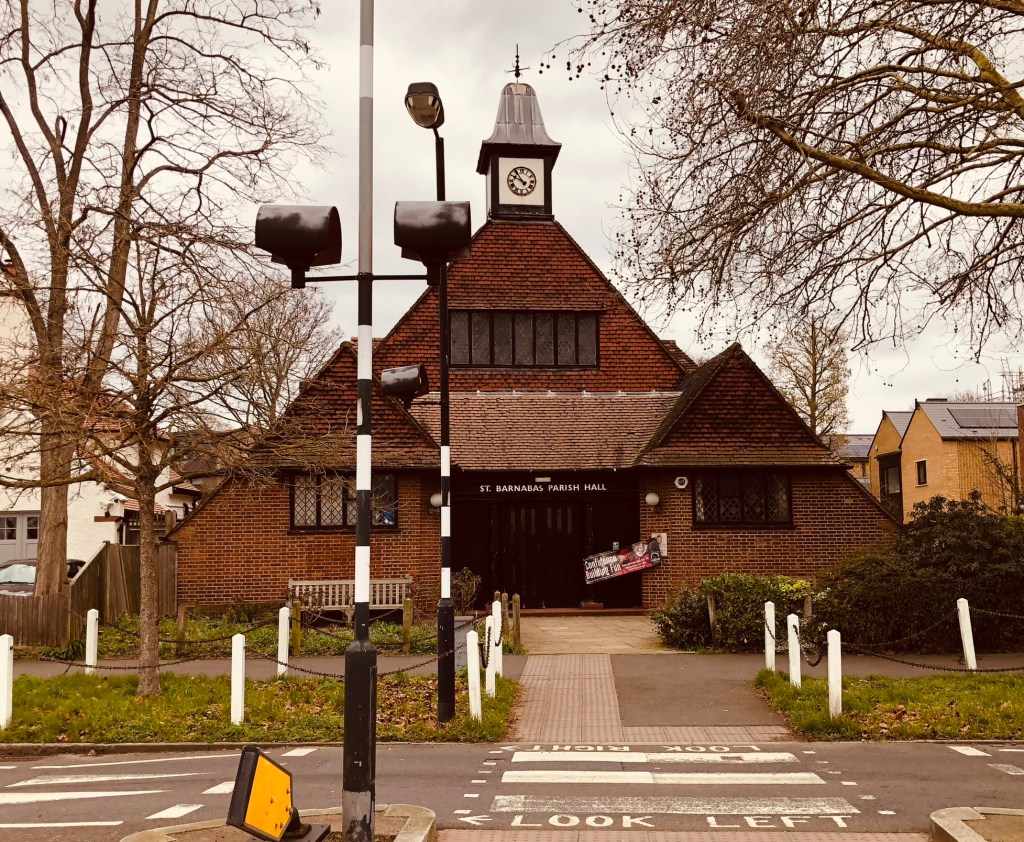
I snaked on through North Dulwich, my attention aroused by a certain style of terraced housing I’d often wondered about, where two adjacent houses have a mirrored configuration of gables descending right down to ground floor level on each outer side, dominating the front facade – appearing as a large M shape. What’s the deal with those? Thanks to today’s ley line, I was driven to find out.
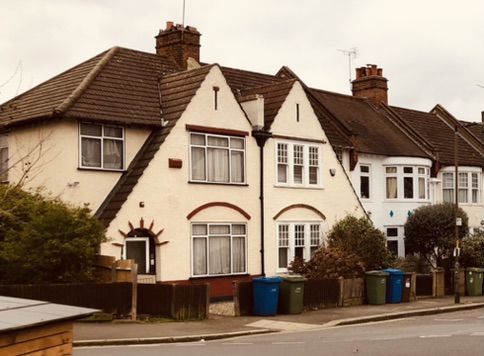
After digging around a bit, I discovered it’s a typical 1930s suburban design, often featuring painted, pebble-dash or stucco render – the kinds of render that became fashionable in the interwar period, but people turn their 21st century noses up at now. These architectural characteristics hark back to a time of city expansion into the suburbs, which this area between Dulwich and Herne Hill presumably would have been part of. These properties were designed to be more affordable and practical, yet still characterful. In essence, the scale of domestic building required meant Victorian and Edwardian decoration was no longer a key objective, but they still wanted to at least nod towards a vague sense of aesthetic consideration. So these steep, sloping gables will have been the very feature that became an easy gesture towards cosy suburban charm, much like the white posts encountered earlier on College Road.
A Black-headed gull bobbed in the pond of Sunray Gardens. A strong wind had caused mini waves. This park led to Casino Avenue, which along with the general surrounding area, had a disorientating feel. The architecture of the homes had a much more provincial air than you’d expect to see sandwiched between Dulwich and Herne Hill.
Research eventually led me to a man called Richard Shawe, who got massively rich from being a lawyer in Britain’s longest trial – a seven year impeachment trial against the first Governor-General of Bengal. With his new spoils, Shawe built a large Georgian Villa and grounds on this site, designed by John Nash in the Palladian style. The villa was named Casina, hence Casino Avenue.
It also turned out that Sunray Gardens, which I’d just walked through was part of the original villa grounds, and the turbulent pond with the black headed gull was the original Casina ornamental fish pond. Also, the Old Burial Ground in Dulwich Village, which I had not long passed, is where Shawe was buried following his death in 1816, and therefore resting in the same site as the Dulwich Hermit. A satisfying mini equinox on the day’s ley line.
What was more interesting though, was the knowledge that I’d just walked through a park which ultimately existed because a trial dragged on for so long that the defence lawyer got loaded from the proceeds, whilst the defendant was financially ruined by the costs, despite his not-guilty verdict. More amusing still is that by the end of the trial, a third of the Lords who were at the opening had since died.
I glimpsed Battersea power station through Poplar Walk, then came to the Carnegie Library where I stopped for lunch – a beautiful terracotta building, with Ionic columns and pilasters and classical pediments that make for a grand entrance. There is a large, spacious cafe inside. It was quite busy, so I found a seat at a window table looking out through the stained glass. I sipped my coffee and flicked through a magazine about squirrels (it wasn’t mine, it was just there). Everything in its Right Place by Radiohead played over the speakers. I agreed with Thom that it was.
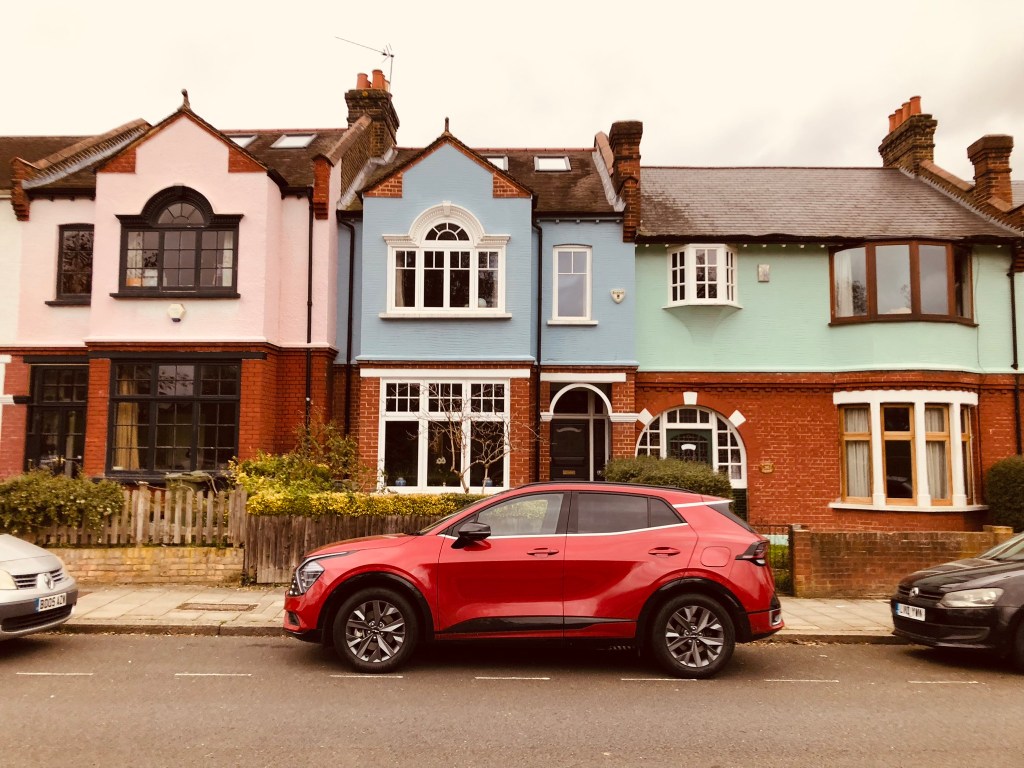
I reached Ruskin Park in Denmark Hill, a park I’d walked past but never been in. It’s a fairly nondescript open field, but has a good view of the city skyline. I navigated some quaint streets with pastel coloured houses until I got to my first pub, a residential street pub called The Cambria.
The Cambria was quiet at 5pm on a Thursday. There wasn’t even anyone behind the bar for a good few minutes. A couple of locals eventually informed me, “he’s upstairs”. I heard a glass smash in another room, which didn’t match the vibe. A game of pool was taking place somewhere, evidenced by the clacking of phenolic resin. The shattering of glass echoed round the empty pub. The barman emerged. I ordered a pint of Otter bitter and chose one of the many available tables.
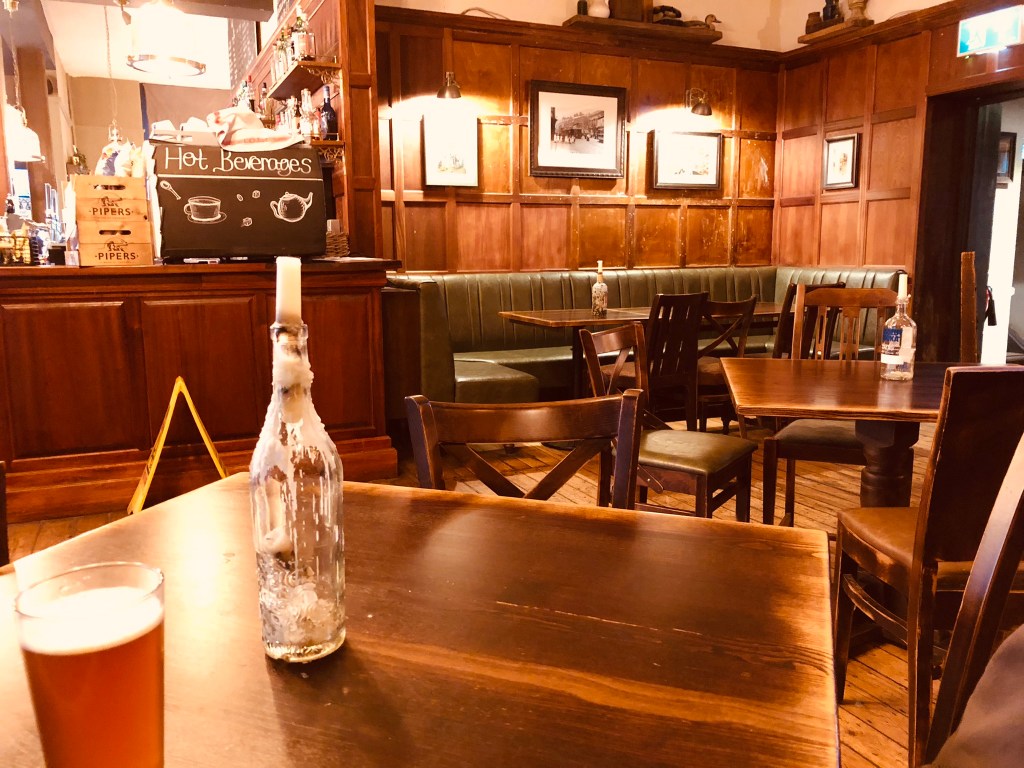
A young lady walked in and asked if there were any jobs going. The barman advised her to drop a CV in. A bolt of nostalgia surged through me. In an age of online applications I was surprised to witness someone physically walking into an establishment and verbally enquiring as to the possibility of gaining employment. It sparked a memory of me traipsing round Plymouth City Centre with a plastic wallet full of CVs, carefully typed out with my GCSE results and Duke of Edinburgh (silver) award, which I’d printed out on our home printer, using inexplicably expensive ink purchased from Rymans. Those were the days.
Unprompted, she confessed to not having any experience, to which he replied, “it’s not rocket science”.
I left the pub and continued walking. The glow of an Excel spreadsheet through a window drew the eye at 5:30pm. I prayed they would clock off soon. The roar of a loud and prolonged yawn came from behind me. I turned to see a man cycling, towing a child in the trailer. This guy had absolutely clocked off for the day. I passed the Paulet Arms ghost pub and cut through the Paulet Road Estate. I get disproportionately excited when the route requires the use of housing estate walkways to honour the line.
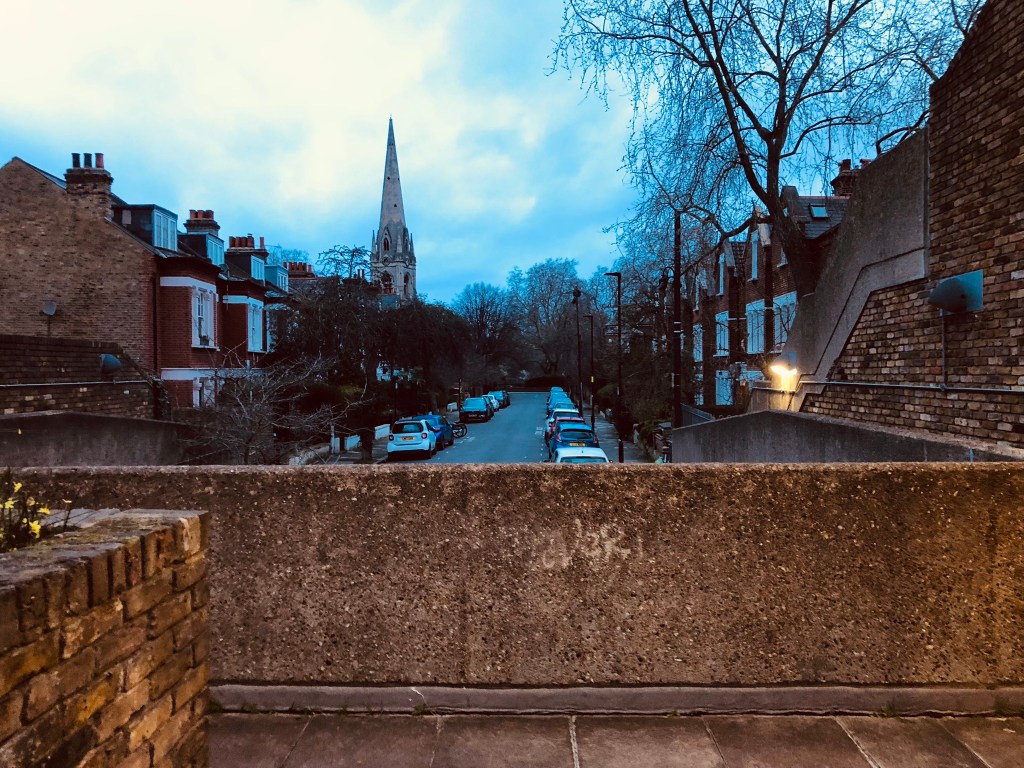
Darkness was setting in. In Myatt’s Fields Park a couple of guys sparred with boxing pads and under the floodlights of an astroturf football pitch a man took shots at a child.
Just beyond Myatt’s Fields I walked down Lothian Road. As I was about to turn right onto Patmos Road there was a strange sight ahead. Two large concrete funnels projected from a geometrically ridged structure. It stood out between the slick modern low-rise housing block and a lovingly landscaped pedestrianised area. What on earth was this thing?
It turns out I was looking at the Camberwell Submarine – a 1970s brutalist structure that does very much resemble a submarine that has strayed a bit off course. But what the hell is it for?
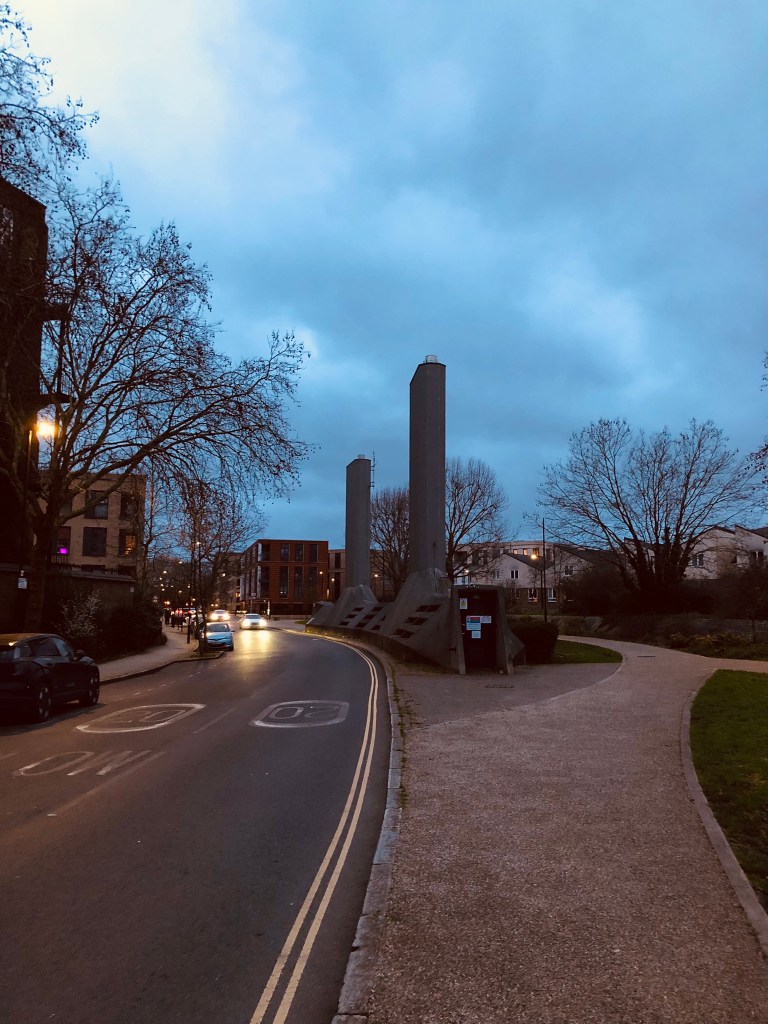
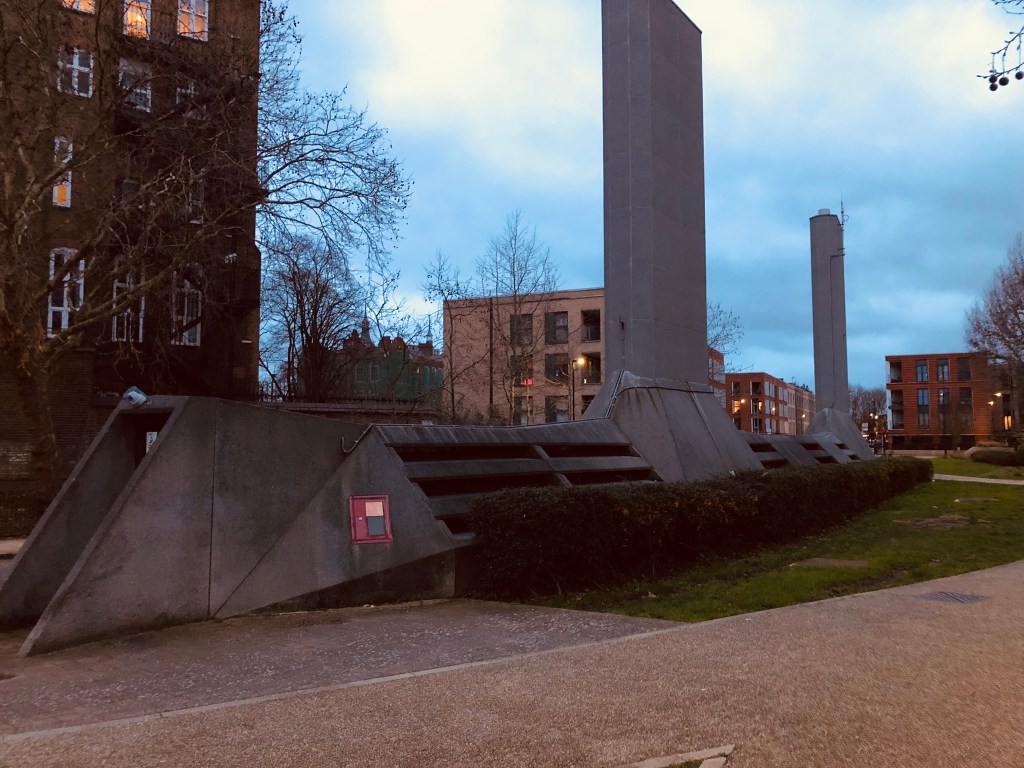
Well, the answer to this question sends us, once again, underground. Just as stink pipes emitted foul air from London’s sewers, the Camberwell Submarine is a massive vent, allowing heat to escape from an underground boiler room serving two nearby social housing estates with heating and hot water.
I then had a flashback. As I approached, its form became familiar. I remembered it from a book I once bought called Inventive Vents, by Lucy Lavers, Judy Ovens and Suzanna Prizeman, who founded the Our Hut architectural education charity. The strapline is “a gazetteer of London’s ventilation shafts”. Now if that’s not a line to hook you in, I’m not sure what is. It was in my basket quicker than you can say Paolozzi Shaft Cover.
This book is a celebration of the myriad ways in which architects have creatively attempted to disguise London’s many flues and grilles. London doesn’t stop at our feet, there’s a whole other dimension below, as already discovered during this walk, through bodies in burial grounds and mausoleums, elaborate Victorian sewer systems, or plant rooms for housing estates. Such underworlds need to emit stuff into the above ground dimension, yet most people don’t like to be visually alerted to this, hence the attempts to either disguise or go the other way and overtly embellish such systems. Occasionally these efforts manifest in something truly unique. They become worthy of landmark status. They stop you in your tracks as you say to yourself, “what the fuck is an undersea watercraft doing in SE5?”, or “why in the name of Lord Jesus Christ is that lamppost slightly thicker than usual?”.
I reached my second pub of the journey, which was The Kennington, in Kennington. I had half a Horizon – a golden ale from Wadworth brewery. It was served in a classic dimpled tankard, which is very satisfying in half pint size. I sat outside and drank it as ambulances screamed by.
It was a quick stop, so I shot off again along the ley line, through Kennington Park and on towards Lambeth. I had to cut through another housing estate which surrounded some kind of sports centre. I made my way through, passing more astroturf pitches, all in use. I caught a glimpse of an exceptional through pass that led to a goal.
I was nearing the Thames, not far from Lambeth palace. I bent around Pratt Walk, which has on one side a beautifully preserved row of Georgian terraced housing with cast iron railings and decorative coal holes on the pavement, then on the other side an austere looking office block. Next to this building was yet another odd structure with a purpose to extract air from the subterranean world beneath us. This time it was an electrical substation serving the adjacent building, which is home to the Metropolitan Police Forensic Science Laboratory, where bullet fragments are examined, shooting scenes are reconstructed and suspects are identified from traces of saliva found on cigarette butts. It was behind these walls where forensic testing revealed the much-feared Croydon Cat Killer to actually be a series of foxes.
Like the Camberwell submarine, this vent was large, absurd and of brutalist architectural lineage. It was built in 1966 and designed by the Metropolitan Police’s own architects department. I know this because it also featured in Inventive Vents.
The Stonepenge to HERE line united two ventilation shafts notable enough to be included in a book. Not only this, both structures seemed visually of a piece with the Stonepenge installation at my starting point. I strode on, satisfied by this notion.
This next part of my journey came with the unsurprising revelation that one can’t simply cut through St Thomas’ Hospital. It stood rudely bang centre of the line, so I’d imagined striding confidently yet forlornly through the hospital as if on the way to greet a sick loved one – albeit sans bouquet, grapes and a Twix – then out some exit the other side. The plan seemed viable to me.
I was able to enter the building at least and began my planned route through the central walkway. Despite this promising start, it wasn’t long before I became a man wandering aimlessly around a hospital he had no purpose to be in, trying to locate an exit, very aware that a staff member might be keen to help me find the non-existent patient I was not trying to find – to which I would have no feasible response other than to pretend I was so stubborn that I wanted to find them on my own terms, or that I’d decided it wasn’t actually that important and I wanted to leave.
Instead I retraced my steps back out and walked around to Westminster Bridge via an alternative route. I had reached the Thames. I passed a lion, then Boadicea and Her Daughters, New Scotland Yard and various other memorials until I was at my next pub, which was slightly unusual.
Tattershall Castle is on a boat, moored on the Thames and accessed by a walkway leading to the deck, which has a little bar and tables. Then you go inside and it’s an absolute labyrinth – a maze of stairs, corridors and different drinking areas. It’s actually a really nice pub interior and it was quite buzzy by the time I got there.
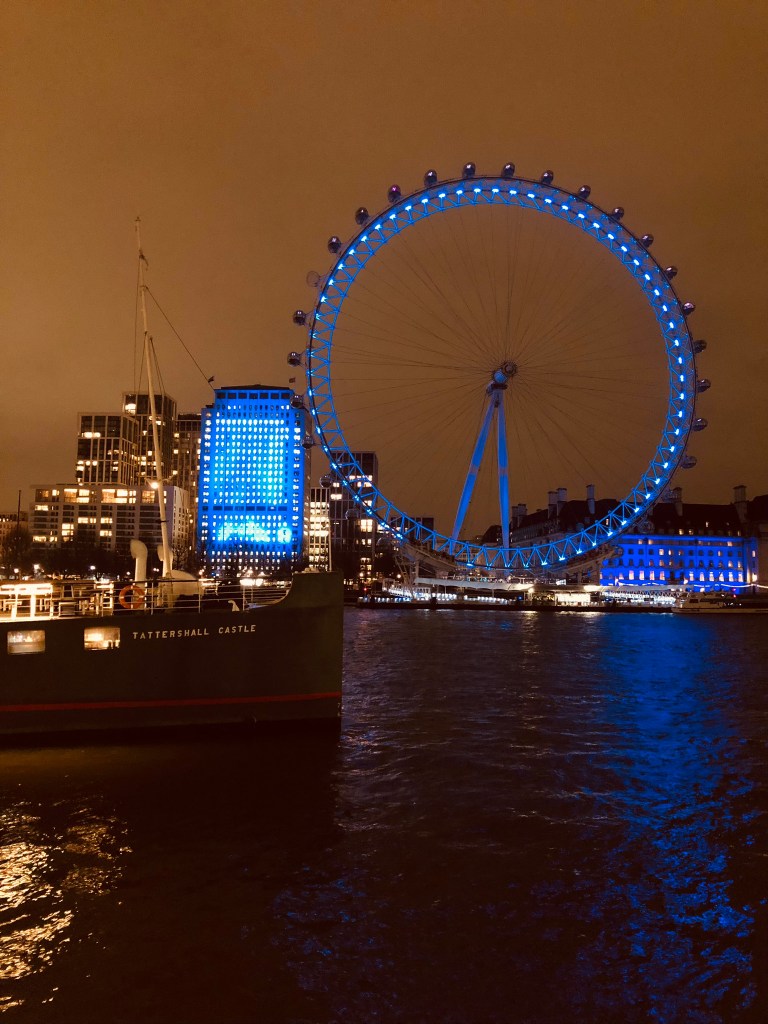
One thing I hadn’t accounted for was the movement of the boat. I’m not sure why, as I’ve long been aware of how boats and water work. It was really quite disorientating being in a room in London which felt exactly like a pub, but was physically moving. If I stayed there much longer than I did I would have started to feel seasick. When I ordered my drink I asked the barman if he was used to the rocking. He said yes and that if I got a few beers in me I’d also be fine. Unfortunately I didn’t have time for that, as I had a gig to walk to in a relatively straight line.
It wasn’t long before I was at my next pub. This pub was two pubs. It’s called the Ship and Shovell. One is not the Ship and the other the Shovell, it’s two separate pubs opposite each other in a little side street, both called the Ship and Shovell. So I visited both of them.
It was busy, with people spilling out onto the street between the pubs, essentially connecting the two via an unbroken chain of drinkers. I had to make a decision as to which one to enter to get my drink. I chose the wrong one. It seemed quieter and smaller, with fewer people at the bar. The issue was I got to the bar marginally after a group of three older men who were asking to try practically all of the cask ales before ordering. They eventually received their drinks and I was poised. Then they realised they wanted crisps. Naturally, they weren’t in a hurry to decide on flavours.
After exchanging quintessentially British rolled eyes and tuts with the barman, I eventually got my drink and took it to the other pub in the pub. There was a better atmosphere in that Ship and Shovell than the other Ship and Shovell. I even got a stool in the corner. A woman asked me to look after her bag whilst she went to the bar. I was deemed trustworthy. It felt good.
The next pub wasn’t far either. They were clustering now. Walking on foot from the suburbs to the city tells the story of urban sprawl in reverse, in which pubs are key parts of the narrative. In this part of London there is practically one on every corner.
The next one was one of those much heralded London pubs – the Harp. Amazingly, I had never been. I approached it via Adelaide Street, with the scent of a 24-hour outdoor urinal in the air – yet another grille to the underworld, only an ever-so-slight underworld a mere foot deep, and filled with piss. I could hold on until the pub.
The Harp did not disappoint. Escaping the uric aroma, I was rewarded with the smell of a proper pub. I gazed down the bar at the conveyor belt of Guinesses, appreciating the mastery of the bar staff, pouring the majority of each pint and allowing them to settle whilst they served the next customer, never losing sight of whose pint was whose. I realised the proper pub smell I was so mesmerised by was probably in large part due to the fact my nostrils were hovering directly above the drip tray. What that said about me, I neither knew nor cared. The drip tray marketing campaign was successful. I ordered a Guinness.
For the second busy pub in a row, I’d managed to find a vacant stool, once again the corner-most stool, everything in view. The atmosphere was restorative. This was the kind of pub that made you glad to be alive in this world, but at the same time glad to sit in the corner and shut everything out. You can’t even get phone signal, and it’s great. With no distractions, I stared down the length of what was a very narrow pub. The scene melted into a frame of colour, light and shadow. Competing voices harmonised. The music of pub.
Nearly at the end of my journey, I shimmied down the narrowest alley in London (Brydges Place) and onto the home straight. The home straight was Charing Cross Road.
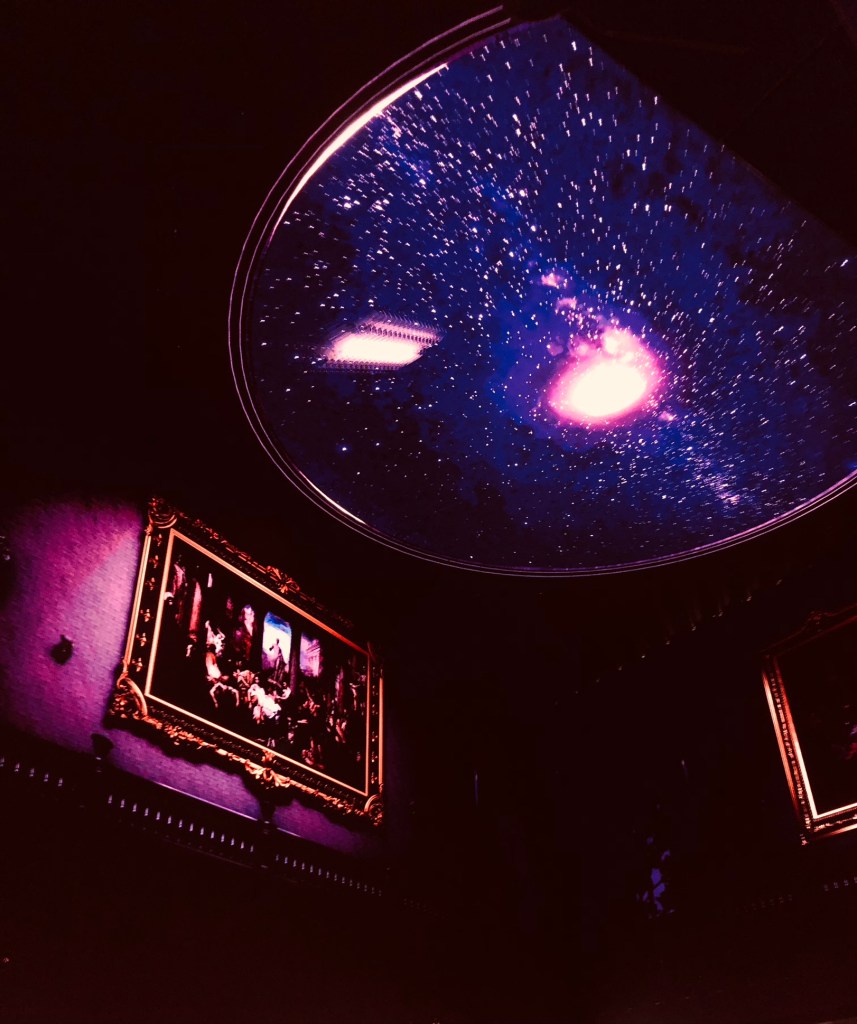
I had reached the Outernet district and queued in a tunnel surrounded by psychedelic LED imagery. I got to the entrance. Where was the venue? Massively under the fucking ground of course! How appropriately on theme. I descended staircase after staircase, sinking deep below ground level. I was in the world of electrical substations, of plant rooms, tube networks, hermit caves, dead plague victims, villa owning lawyers and pioneering gallery founders, and the urine of drunk Business Development Directors caught short after Thursday night drinks.
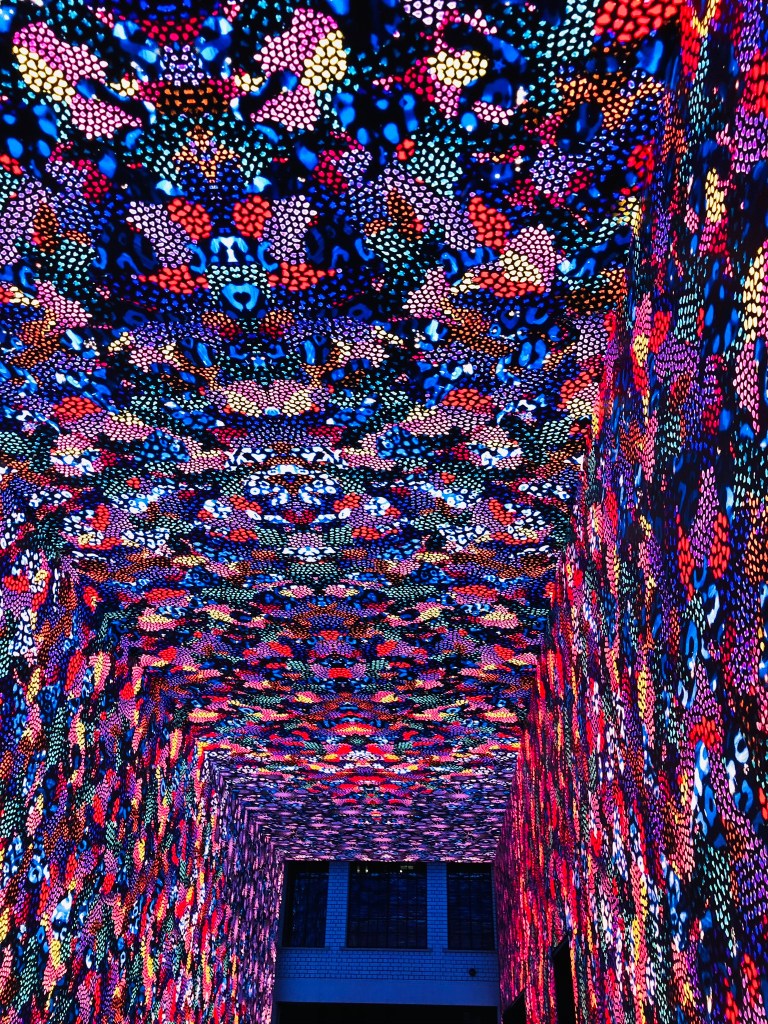
Everything was very high tech. A degree of thought had to precede most tasks, be it operating taps, hand dryers or e-lockers, at least for a millennial like myself. But whilst Gen Z may be more adept at using automated systems, they seemed less confident ordering drinks at an analogue bar. I had that one down at least.
One of the highlights of the gig was the persistent accidental namechecking of the band we were there to see. You don’t realise how often British people instinctively apologise when squeezing past each other at crowded events, that is until you attend a Sorry gig. Under this circumstance it becomes endlessly amusing. I passed the time waiting for the band to come on, imagining a stadium full of people slipping past each other whilst muttering “Harry Styles”.
The gig was very good. Lead singer, Asha Lorenz has an oddly compelling stage presence. She didn’t look entirely comfortable, which may just be her natural energy, but whatever it was, it radiated a specific intensity – a polarity of sheepishness and power, as sonic nebulas of guitar and synth coalesced around her controlled, occasionally tormented vocal.
There was one last treat for myself. As previously mentioned, one of the key selling points for me was the Guided by Voices sample – a short blast of singer Robert Pollard shouting HOT FREAKS!, from the song of the same name, from the greatest album ever made. During that part of the song, Pollard’s face filled the enormous LED screen that stretched across the entire stage backdrop. A large smile appeared across my face.
The gig finished. I hauled my tired legs up the many stairs, briefly entering above ground London, before plunging myself back into the London Underground. I was messing with the equilibrium, popping up and down like an indie flâneur Whack-a-Mole. By this stage I was sick of the subterranean. I couldn’t have been more relieved to get the Overground for the home stretch.


Leave a comment